Dog Age Chart: How Old Is Your Dog in Human Years?
Every dog owner has wondered it at some point: what would my dog’s age actually be if she were human? The old “multiply by seven” rule is the answer most of us grew up with, and it’s also wrong. A dog age chart gives a far better picture, because dogs age unevenly fast at first, then slower and a big dog ages differently than a small one. Here’s a chart you can actually rely on, and the reasoning behind it.
The Dog Age Chart at a Glance
| Dog’s Age | Small Breed (up to 20 lb) | Medium Breed (21–50 lb) | Large Breed (51–90 lb) | Giant Breed (90+ lb) |
|---|---|---|---|---|
| 1 year | 15 | 15 | 14 | 12 |
| 2 years | 24 | 24 | 22 | 22 |
| 4 years | 32 | 32 | 32 | 34 |
| 6 years | 40 | 42 | 45 | 49 |
| 8 years | 48 | 51 | 55 | 61 |
| 10 years | 56 | 60 | 66 | 74 |
| 12 years | 64 | 69 | 77 | 87 |
| 14 years | 72 | 78 | 88 | — |
These numbers are widely used estimates, not a medical formula. Think of them as a starting point for understanding your dog’s life stage, not a precise translation.
Why “One Dog Year Equals Seven Human Years” Is a Myth
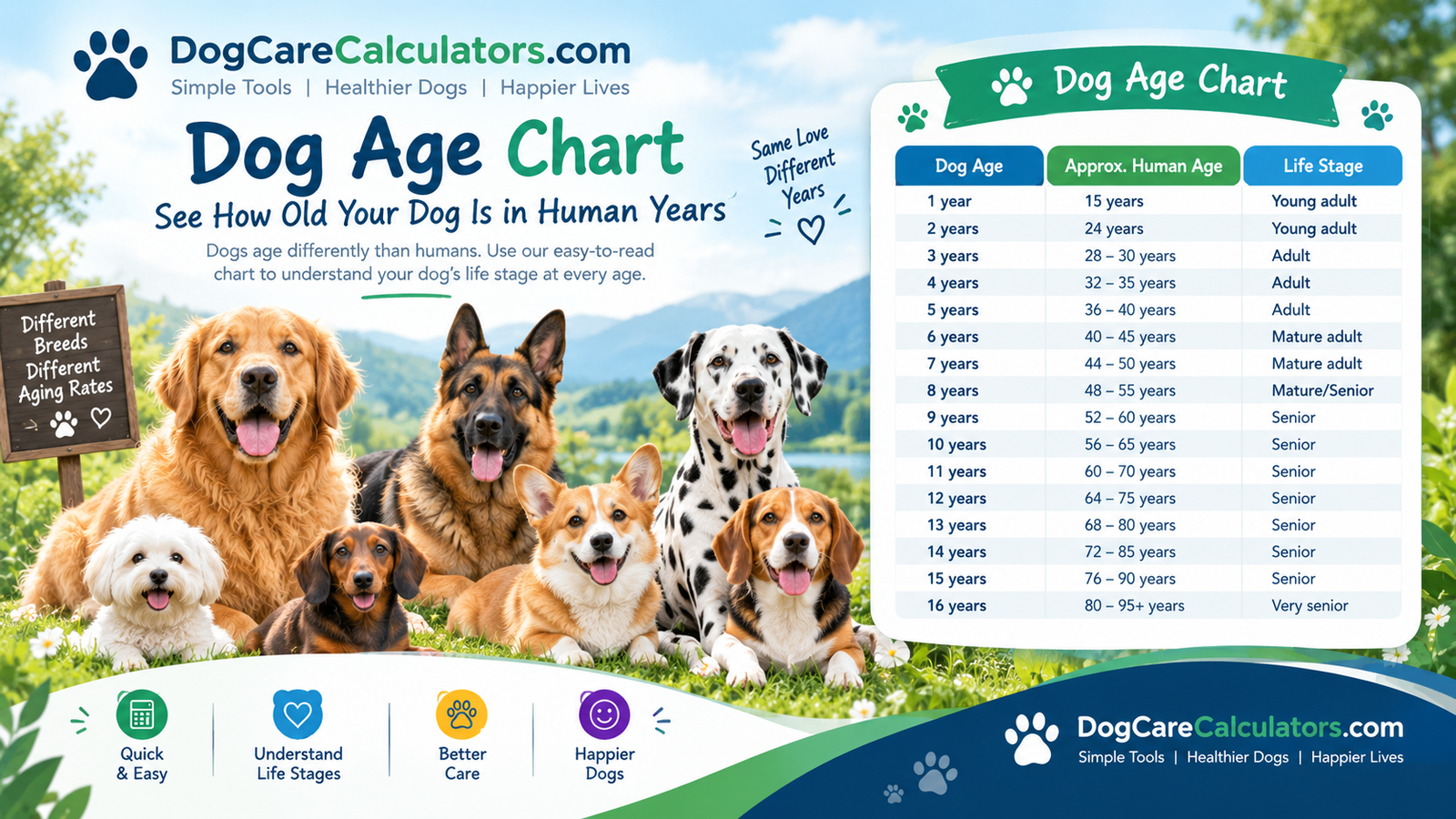
The times-seven rule assumes dogs age at a steady pace their whole lives, which simply isn’t true. A one-year old dog isn’t a human seven-year-old she’s already sexually mature, closer to a fifteen-year-old teenager. After that first fast sprint, aging slows down and settles into a more gradual pace, roughly four to seven “human years” for every year that passes. The old rule sticks around because it’s catchy, not because it’s accurate.
How Breed Size Changes the Math
Here’s the part that surprises most people: bigger dogs age faster in their later years, not slower. A Great Dane and a Chihuahua born on the same day will be in very different places by age eight. Small breeds mature quickly but then age gradually, often living well into their teens. Giant breeds mature a little slower as puppies but decline faster later on, which is why their expected lifespans tend to be shorter. That’s why a single number for “dog years” was never going to work size has to be part of the calculation.
Dog Life Stages Beyond the Numbers
A chart tells you a number, but life stage tells you more about what to actually expect. Puppyhood runs through the first year, full of growth and learning. Young adulthood follows, when most dogs are at their physical peak. Middle age creeps in earlier than owners expect often by six or seven for larger dogs — bringing the first signs of a slower metabolism or stiffer joints. Senior years bring their own changes: greying fur, less stamina, and a greater need for regular veterinary care.
Using the Chart as a Health Guide, Not a Verdict
The real value of a dog age chart isn’t the number itself it’s what that number should prompt you to do. A dog whose “human age” lands in the senior range benefits from more frequent vet checkups, closer attention to weight and joint health, and diet adjustments suited to an aging body. Use the chart as a nudge to pay attention, not as a diagnosis of how your dog is doing.
Frequently Asked Questions
Is the “multiply by seven” rule ever accurate?
Only by coincidence, around middle age for some medium-sized dogs. Early on it badly underestimates a puppy’s maturity, and later in life it underestimates how much a large dog has aged.
Why do small dogs live longer than large dogs?
It’s not fully understood, but large breeds seem to age faster at the cellular level, and rapid growth as puppies may play a role. Whatever the cause, it’s a consistent pattern across breeds.
What age is considered “senior” for a dog?
It depends on size. Small breeds are often not considered senior until around 10–12, while giant breeds can reach that stage by 6–7.
Does neutering or spaying affect a dog’s aging?
It can influence lifespan and certain health risks, but it doesn’t meaningfully change how fast a dog ages year to year the way breed size does.
Should I make health decisions based on a dog age chart?
Use it as general context, not a medical guide. Your vet can assess your dog’s actual condition, which matters far more than a number on a chart.